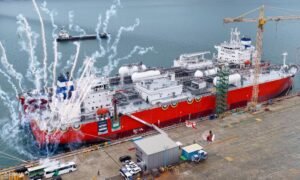

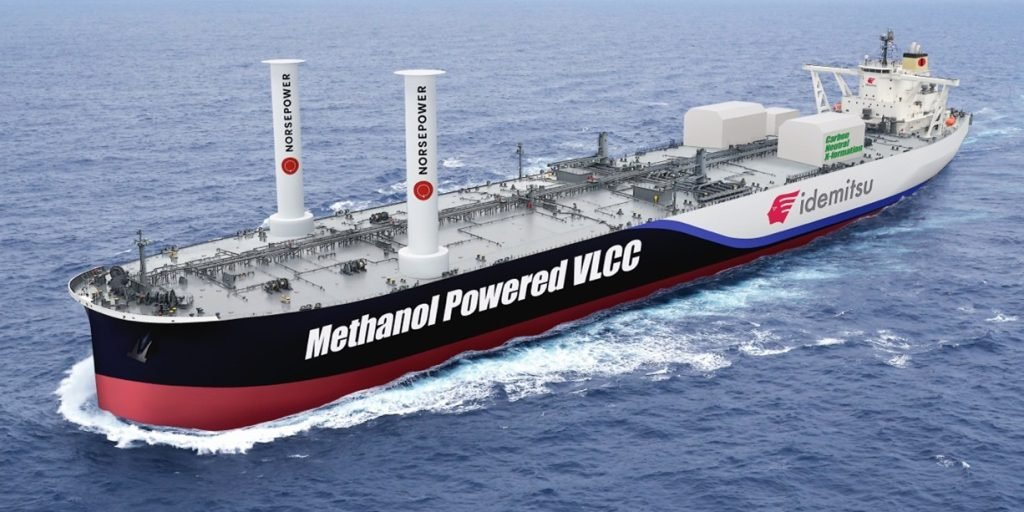
Idemitsu Tanker has chosen Norsepower rotor sails for two very large crude carriers currently being built in Japan, marking the first time the wind-assist system will be deployed on VLCCs.
The vessels are under construction at Japan Marine United (JMU) and Nihon Shipyard (NSY), with the first delivery slated for late 2028.
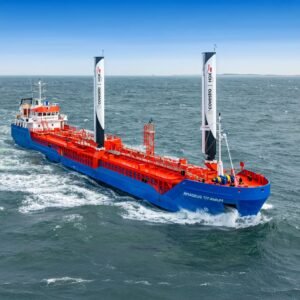
Each newbuild will be equipped with two 35×5-metre explosion-proof rotor sails.
The units form part of Idemitsu’s wider plan to integrate energy-saving technologies and prepare its next generation of tankers for lower-carbon fuels, including methanol.
In a statement, the company said: “Idemitsu Tanker is accelerating the implementation of new technologies and is committed to realizing a carbon-neutral (CN) society by achieving both a stable energy transportation and a reduced environmental impact. By equipping our new VLCCs with the Norsepower Rotor Sail™, we are not only investing in fuel savings and emission reductions but also taking a decisive step towards the decarbonisation of long-haul shipping. This project reflects our philosophy of combining reliable operations with innovation to serve global energy needs responsibly.”
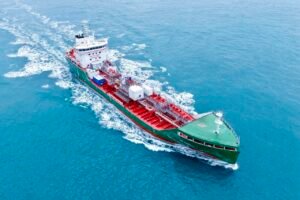
For Norsepower, the contract marks an expansion of its footprint in the tanker market and its first newbuild project in Japan. The company already has 22 rotor sails in operation across tankers ranging from chemical carriers to MR and LR vessels, VLGCs and LCO₂ carriers.
“This is a defining moment for Norsepower and for wind propulsion in global shipping,” CEO Heikki Pöntynen said. “Partnering with Idemitsu Tanker and JMU on the first VLCCs with rotor sails and doing so as our first newbuild project in Japan, is a tremendous step forward. Japan has already become the single biggest market for Norsepower projects, and this collaboration confirms both the trust in our technology and its relevance across all tanker segments.”
Norsepower’s modernised Flettner rotor system uses the Magnus Effect to generate thrust, reducing main-engine load. The firm cites typical fuel savings of 5–25%, depending on wind conditions, routing and operational patterns, with higher results possible in favourable environments.