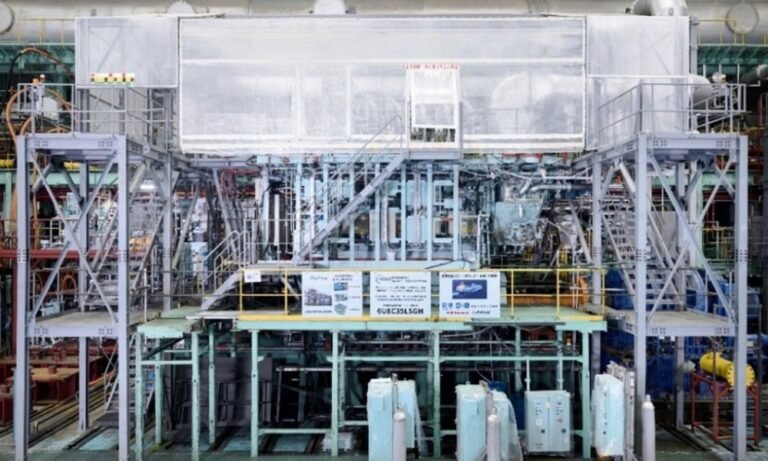
A consortium of Japanese companies has successfully completed hydrogen co-firing operations across all cylinders of a large two-stroke marine engine, marking a key milestone in the development of hydrogen propulsion for deep-sea shipping.
The engine achieved a hydrogen co-firing ratio of over 95% at full (100%) load, demonstrating both significant greenhouse gas emissions reduction and stable engine performance. Further verification testing will continue to optimise operations under hydrogen conditions.
The project brings together Japan Engine Corporation (J-ENG), Kawasaki Heavy Industries, Mitsui OSK Lines (MOL), MOL Drybulk, Onomichi Dockyard, and classification society ClassNK, combining expertise across engine design, shipbuilding, fuel systems, and regulatory oversight.
While hydrogen vessel development has progressed globally, most projects to date have focused on small-scale, short-range applications such as tugboats or passenger vessels using compressed hydrogen.
In contrast, this initiative centres on a low-speed, high-efficiency two-stroke hydrogen-fuelled engine (6UEC35LSGH) paired with liquefied hydrogen fuel, enabling long-distance, high-output operations suitable for oceangoing merchant ships.
The consortium described the achievement as a “major technological milestone” toward the practical deployment of large hydrogen-powered vessels.
Following completion of full-scale verification, the engine is scheduled for delivery in January 2027, when it will be installed on a 17,500 DWT hydrogen-fuelled multi-purpose vessel being built by Onomichi Dockyard.
A marine hydrogen fuel supply system (MHFS) for the vessel is being developed by Kawasaki Heavy Industries and will be integrated onboard.
The vessel is set to undergo three years of demonstration operations from FY2028, operated by MOL and MOL Drybulk, with ClassNK conducting safety evaluations throughout the project lifecycle.
The development signals growing momentum behind hydrogen as a potential zero-emission fuel for deep-sea shipping, though further work remains on scaling infrastructure, fuel supply, and onboard storage systems.