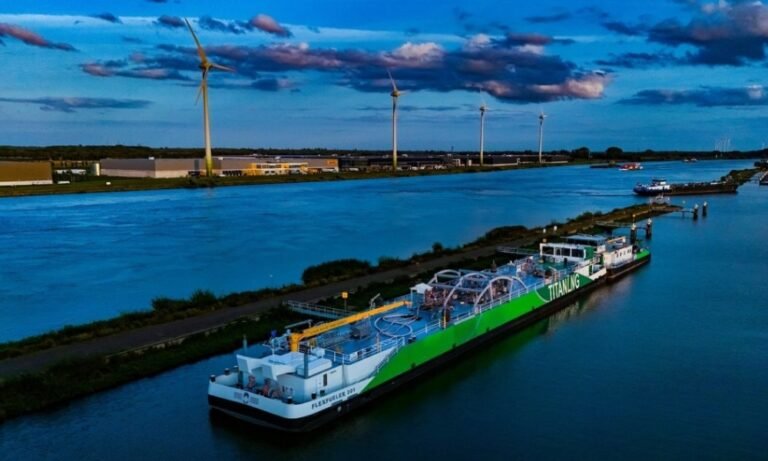
Titan Clean Fuels (Titan), a Netherlands-based marine fuel supplier, has signed an offtake agreement with TURN2X to supply e-methane to the maritime sector from 2028.
The deal will see TURN2X produce e-methane at its plant in Miajadas, Spain, with Titan distributing the fuel through its bunker network, which spans around 52 ports using seven bunker vessels.
TURN2X’s facility converts renewable electricity and biogenic CO₂ into ISCC-certified e-methane, which is then injected into the gas grid and transported to major European ports for bunkering.
E-methane offers the potential for net-zero greenhouse gas emissions on a well-to-wake basis, depending on engine and onboard technology. It also delivers up to a 95% reduction in nitrogen oxides (NOx), alongside near-zero sulphur oxides (SOx) and particulate matter emissions.
These emissions benefits position e-methane as a viable pathway for FuelEU Maritime compliance, including overcompliance, enabling participation in pooling and banking mechanisms such as Titan’s FuelEU pool.
TURN2X’s product qualifies as a renewable fuel of non-biological origin (RFNBO), allowing shipping companies to double-count emissions reductions between 2025 and 2033. If uptake remains low, ships may face a minimum 2% RFNBO requirement from 2034.
The agreement also supports EU energy security goals, as the bloc moves to phase out Russian LNG imports by 2027, increasing the need for scalable green fuel alternatives.
Phillip Kessler, CEO of TURN2X, said: “We are happy to partner up with Titan and Molgas, leaders in clean marine fuels, to decarbonize the shipping industry with e-Methane, the fuel of choice for more and more companies in the maritime sector.”
Caspar Gooren, Commercial Director of Renewable Fuels at Titan, added: “TURN2X are true green fuel pioneers and we are excited by the significant potential of this partnership. Its team’s approach to e-Methane supply is scalable: the green fuel can be produced in regions with high volumes of low-cost renewable electricity like Spain, injected into the existing gas grid, and delivered in ports where maritime off-takers need it.
“The methane pathway – via LNG, liquefied biomethane (LBM/bio-LNG) and e-Methane – allows shipowners to decarbonise step-by-step while protecting their existing investments. By using established infrastructure, this route also offers the lowest total cost of compliance along the way. Looking at the destination, all e-fuels have similar production processes, so the price will mainly be led by the availability, costs and scalability of supply-side infrastructure – where methane has a clear head start.”