
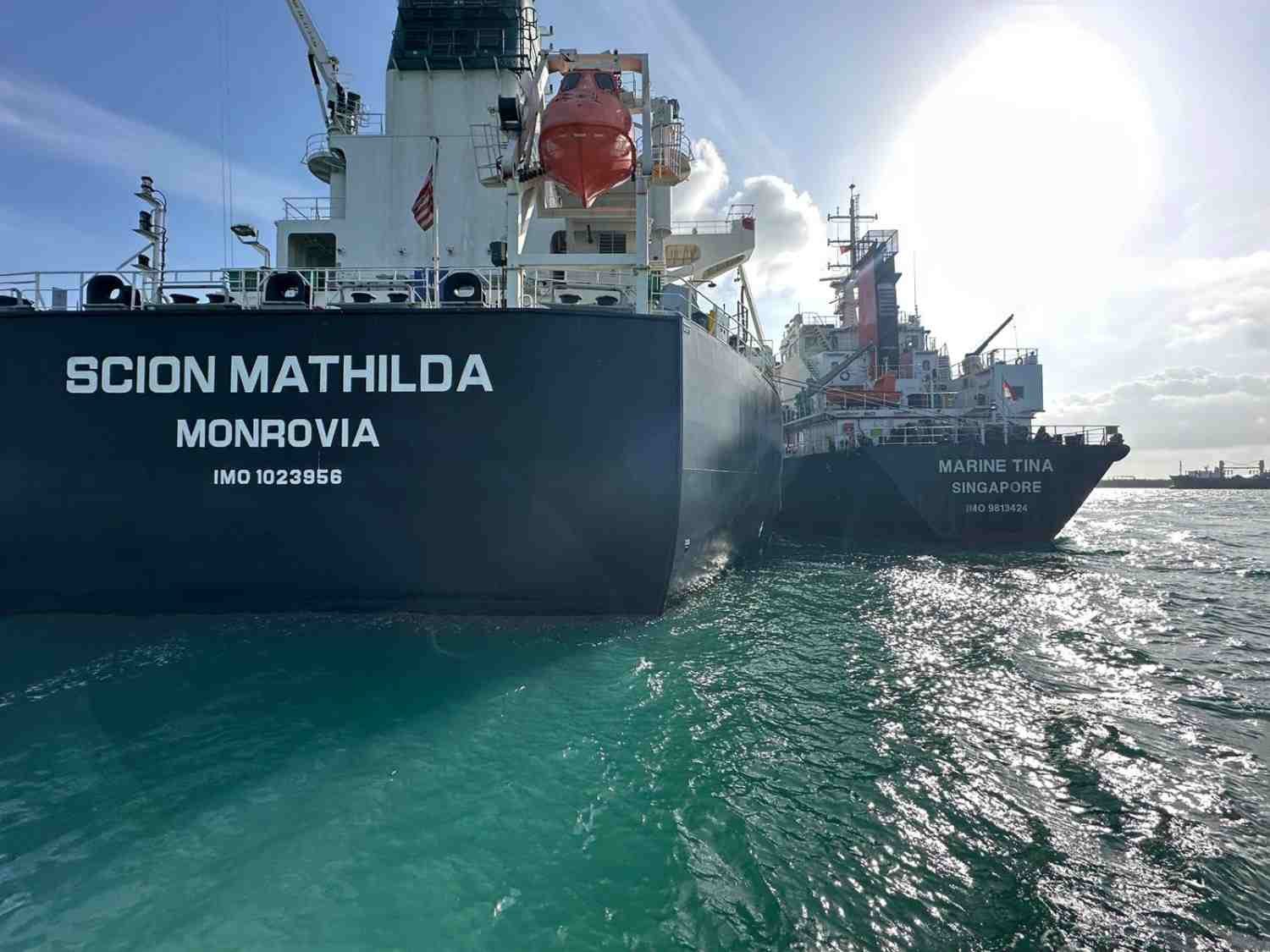
Vitol Bunkers and Olam Agri have completed a bio-bunkering operation in Singapore using VLSFO co-processed with Cashew Nutshell Liquid (CNSL), with the fuel later consumed on a commercial voyage.
The companies said the operation is the world’s first involving co-processed CNSL VLSFO and demonstrates that the fuel can be used without changes to normal vessel operations.
Vitol Bunkers Supplies Co-Processed VLSFO
The Scion Mathilda was supplied with 246.5 tonnes of VLSFO in Singapore, including 34.5 tonnes of co-processed CNSL VLSFO and 212 tonnes of conventional VLSFO.
Vitol Bunkers supplied the fuel, which was procured by Olam Agri’s ocean freight business.
The vessel later consumed the fuel on a voyage from Caofeidian in China to Rotterdam in the Netherlands, followed by a ballast leg to Barcarena in Brazil.
During the voyage, the vessel used 34.1 tonnes of co-processed VLSFO, alongside 1,354 tonnes of conventional VLSFO and 101 tonnes of MGO.
No operational issues were reported.
Olam Agri Reports CO2e Savings
The co-processed VLSFO has a greenhouse gas intensity of 2.02 gCO2e/MJ, according to the companies.
They said the fuel delivered at least 120 tonnes of CO2e savings compared with conventional VLSFO on an equivalent basis.
The fuel required no additional onboard handling or treatment.
Vitol Uses Cashew Processing By-Product
CNSL is a by-product of cashew processing and has previously faced challenges as a marine fuel because of compatibility and handling concerns.
Vitol’s process incorporates CNSL into the refinery stream rather than directly blending it into marine fuel.
The resulting VLSFO meets the RMG 380 specification and has the same chemical composition and quality as conventional fuel, according to Vitol and Olam Agri.
The companies said this removes the need for additional permissions or special charter-party clauses.
Olam Agri Sees Potential for Marine Fuel
Martin Fynbo, Head of Bunkers at Olam Agri’s ocean freight business, said the trial demonstrated that CNSL could provide greenhouse gas reductions while maintaining vessel performance.
Vitol Bunkers Trading Manager Sherman Yeo said the operation showed that co-processed VLSFO could be supplied and consumed at sea without affecting normal vessel operations.
The companies said CNSL could become an additional source of lower-carbon marine fuel as shipping faces tighter emissions requirements towards 2030.