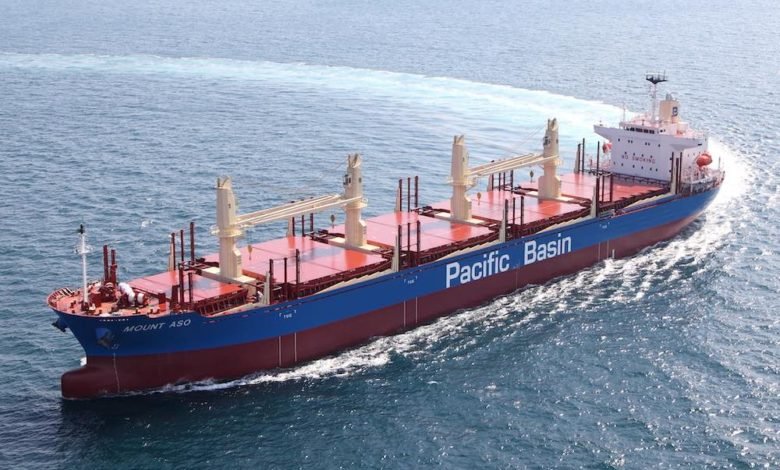
Pacific Basin Shipping Limited has revised its newbuilding programme, cancelling planned dual-fuel Ultramax vessels and replacing them with conventionally fuelled tonnage, citing continued uncertainty over global decarbonisation rules.
The company said it has terminated agreements signed in November 2024 with Nihon Shipyard Co. and Mitsui & Co. for four 64,000 dwt dual-fuel Ultramax vessels.
In their place, Pacific Basin has ordered four conventionally fuelled Ultramax newbuildings of the latest fuel-efficient design for a total of $156.8 million, with deliveries scheduled between 2028 and mid-2029.
The agreement with Mitsui includes an option to acquire two methanol dual-fuel Ultramax vessels by February 2027, for delivery between April 2030 and March 2031.
Separately, the company has contracted Jiangmen Nanyang Ship Engineering Co., Ltd. to build two 40,000 dwt Handysize vessels for $59.6 million, due for delivery in the second half of 2028. These ships will follow the same fuel-efficient, open-hatch design as four Handysize vessels ordered in December 2025.
CEO Martin Fruergaard said:
“The disciplined renewal and growth of our fleet with modern, efficient ships is a core priority for Pacific Basin, so that we can continue to meet strong customer demand, comply with tightening fuel-efficiency regulations, increase our market outperformance and deliver long-term shareholder value. These newbuilding commitments align well with that priority, and the importance of having such vessels of super-efficient designs cannot be overstated in the current high-fuel-cost environment.
The transactions have been agreed on attractive terms in today’s market for newbuildings delivering in 2028 and first half 2029, and with shipbuilders of strong reputation who we know well.
Converting our order for four dual-fuel Ultramax newbuildings to conventionally-fuelled vessels reduces unnecessary near-term capital expenditure and is a financially prudent response to renewed uncertainty around the timing and final shape of a global regulatory framework to drive the maritime green fuel transition following the failure to adopt IMO’s previously agreed Net-Zero Framework (NZF) in October 2025 amid political divisions between member states.
While we expect a NZF-type global mechanism to be adopted in some form in due course and we remain committed to our decarbonisation journey, we believe it is in our shareholders’ best interests to avoid near-term investment in higher-cost dual-fuel vessels until clearer regulatory support emerges. The option to acquire two dual-fuel methanol newbuildings preserves our flexibility to re-enter that market at the appropriate time, while we continue to invest in energy-efficiency measures and position ourselves for priority access to alternative fuels and prepare for new and tighter greenhouse gas regulations ahead.”
Following the changes, Pacific Basin’s orderbook comprises six Handysize and four Ultramax newbuildings, alongside an option for two dual-fuel Ultramax vessels.